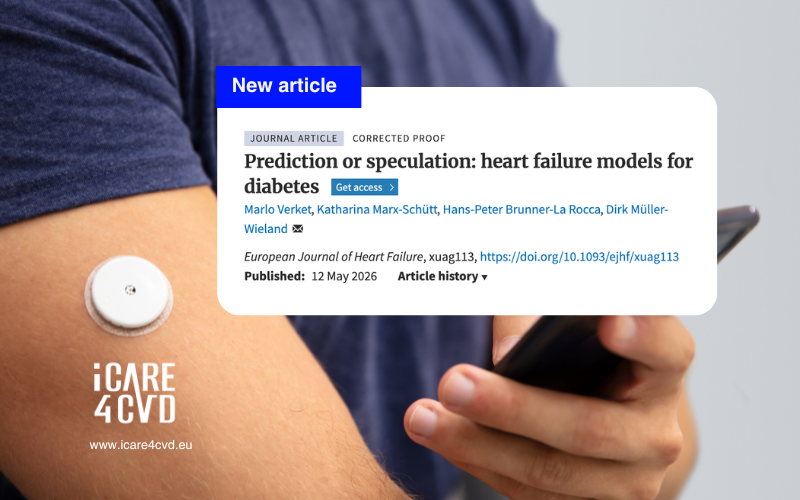
Can we predict heart failure in people with diabetes – or are we just speculating?
That’s the question at the heart of a recent editorial in the European Journal of Heart Failure, co-authored by four iCARE4CVD members: project coordinator Prof. Hans-Peter Brunner-La Rocca, diabetologist/endocrinologist Prof. Dirk Müller-Wieland, cardiologist Univ.-Prof. Katharina Marx-Schütt and data scientist Marlo Verket.
The editorial responds to a large meta-analysis that evaluated over 50 prediction models designed to identify people with type 2 diabetes who are at risk of developing heart failure or being hospitalised for it.
The finding? Despite the sheer number of models, only one demonstrated good predictive performance – and none have been tested prospectively in clinical practice.
In other words: the tools exist on paper, but they’re not yet ready to guide real-world decisions.
The editorial maps out why and what it would take to change that. The authors highlight three main challenges: models need better calibration and external validation across diverse populations; they need to incorporate sex-specific risk factors (most current models treat men and women identically, despite clear evidence they shouldn’t); and they need to be tied to interventions that actually improve outcomes – not just predict risk.
There’s also an important blind spot the paper calls out: type 1 diabetes is almost entirely absent from this field of research, despite the fact that cardiovascular disease accounts for up to 44% of deaths in that population.
For iCARE4CVD, this lands close to home. The project was built on exactly the premise the editorial argues for: that better cardiovascular outcomes require combining clinical expertise with advanced data science – richer data, smarter models, and rigorous prospective validation.
The paper closes with a call that reflects iCARE4CVD’s own roadmap: prediction models need to be embedded in outcome trials, and risk-driven interventions need to be shown to reduce real events and not just improve a statistical score.