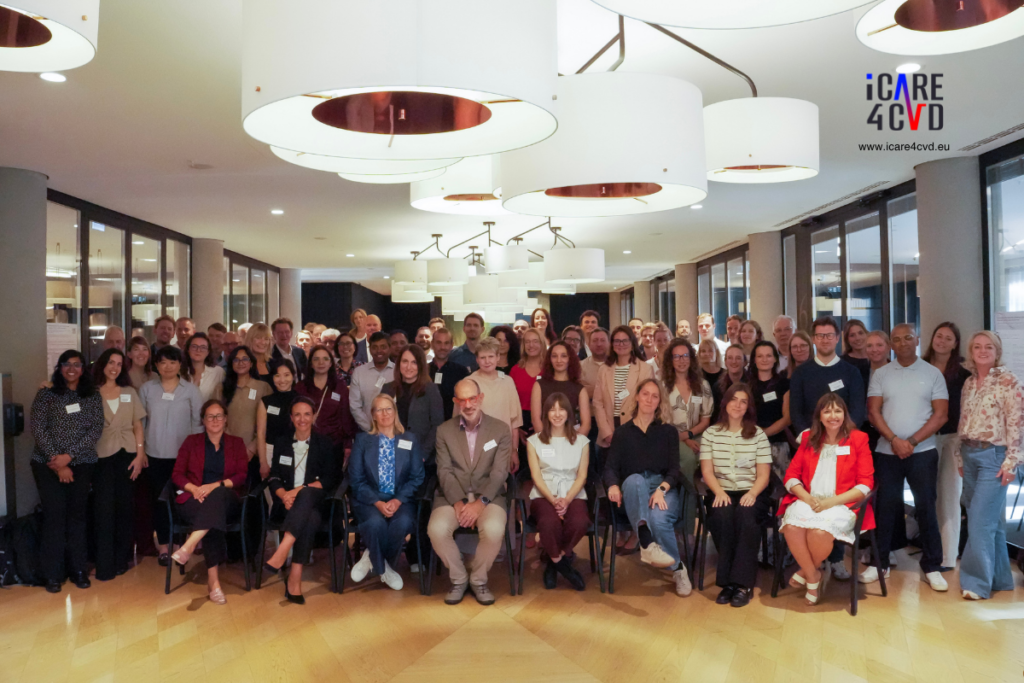
Once a year, the iCARE4CVD consortium comes together to look at how far we have come – and where we need to go next.
On 26–27 August, 75 consortium members from 40 partner organisations gathered in Munich for our fourth Annual Consortium Meeting, hosted by Amgen. Over two days, we stepped away from our usual online meetings, labs, hospitals and offices to share what we have achieved over the past year, exchange ideas and focus on what comes next.
A lot of science, plenty of discussion – and an opportunity to see how the different pieces of iCARE4CVD are coming together.
A year of progress
Since we last came together in August 2025, a lot has happened across iCARE4CVD.
Our federated database is up and running, bringing together data from over 30 cohorts while allowing partners to keep sensitive patient data securely at its source. More cohorts have been added over the past year, giving researchers a growing resource to explore questions across different patient populations.
The consortium has also started to put these data to work. Researchers are combining information from different heart failure studies to better understand biomarkers linked to disease progression and treatment response – helping us investigate why patients with the same condition may respond differently.
At the same time, we are learning more about what patients want and need from personalised care. Research into digital health showed that preferences vary considerably between people – an important reminder that personalised medicine is not only about finding the right treatment, but also about how care and digital tools are designed around the individual.
We are also moving closer to patients with TAILOR-HF, a new observational study that will follow around 600 people with heart failure across seven countries. The study will help us better understand why patients respond differently to treatment and generate new data to support our work towards more personalised cardiovascular care. The first patients are expected to join in September 2026.
In parallel, we are preparing CAROLA-T1, our clinical study in people with type 1 diabetes and chronic kidney disease. By investigating a new combination treatment in this specific group of patients, the study brings iCARE4CVD’s personalised approach into the clinic – looking at how treatment can be better tailored to people with different cardiovascular risks and needs
Across the project, research questions are becoming more concrete and we have published 11 new scientific papers over the past year.
In Munich, we had the chance to connect these developments and hear directly from the teams behind them. Partners shared updates from across the project, while posters and smaller interactive sessions gave us more space to dig into specific questions and challenges – from AI and digital biomarkers to patient care pathways, clinical study implementation and regulatory readiness.
Different expertise, one shared goal
One of the strengths of iCARE4CVD is the range of people and organisations working together. Researchers, clinicians, industry partners, technology experts and patient representatives bring different expertise – and different perspectives – to the same challenge: how can we move towards cardiovascular care that better reflects the individual patient?
The meeting gave us the chance not only to present progress, but to challenge ideas, identify gaps and work through questions together.
For Maria Sejersten Ripa, iCARE4CVD Industry Lead at Novo Nordisk, this collaboration is essential to turning the project’s research into something that can ultimately make a difference for patients:
“No single company, hospital or university has all the pieces of the puzzle. Personalised cardiovascular care requires large datasets, diverse expertise, patient involvement and a pathway to implementation in clinical practice. Public-private partnerships allow us to combine strengths rather than work in silos. That’s what makes iCARE4CVD powerful. We can learn from more patients, test ideas across different healthcare settings, and develop solutions that are more likely to be adopted in the real world.”
Listening as well as sharing
An important part of the meeting was also hearing perspectives from outside our day-to-day project teams.
Our Patient Advisory Board and Scientific Advisory Board joined the discussions on the final day, providing patient and independent scientific perspectives on our progress and where we go next.
Reflecting on the meeting, Farooq Mohammed, member of the iCARE4CVD Patient Advisory Board, shared:
“I came home from Munich humbled and inspired. It’s always a privilege to be with incredibly clever people doing amazing work and to be able to bring the patient perspective into those conversations is . This year particularly, I felt we were beginning to see how all those different pieces might come together to genuinely change the way cardiovascular disease is treated in the future and that is super exciting. I’m already looking forward to seeing what progress has been made when we come together next year in Milan!”
After two busy days, we leave Munich with new ideas, clearer priorities and plenty to build on – and, importantly, a better picture of how the work happening across iCARE4CVD connects as we move into the next phase of the project.
Thank you to Amgen for hosting us, and to everyone who presented, asked questions, shared ideas and contributed to the discussions.
See you at the next one! 💙