Can artificial intelligence help doctors better understand why patients with heart failure respond differently to treatment?
At the European Society of Cardiology (ESC) Congress 2026, Hajar Ghaem Sigarchian, researcher at Thomas More University of Applied Sciences and member of the iCARE4CVD consortium, presented research exploring how causal machine learning could contribute to more personalised heart failure care.
Heart failure is a complex condition, and patients do not always respond to the same medications or doses in the same way. Finding the most appropriate treatment often involves gradually adjusting medication doses, a process known as medication titration.
The research presented by Hajar explores whether causal machine learning, an approach that uses data to investigate cause-and-effect relationships, could help researchers better understand differences in treatment response and identify which patients may benefit most from particular treatment strategies.
The findings illustrate the potential of artificial intelligence to support more personalised treatment decisions. However, further research, including prospective clinical validation, is needed before these approaches can be introduced into routine clinical practice.
This work contributes to iCARE4CVD’s broader ambition to advance precision medicine in cardiovascular care, moving beyond one-size-fits-all approaches towards treatments that better reflect each patient’s individual characteristics and needs.
Watch the interview
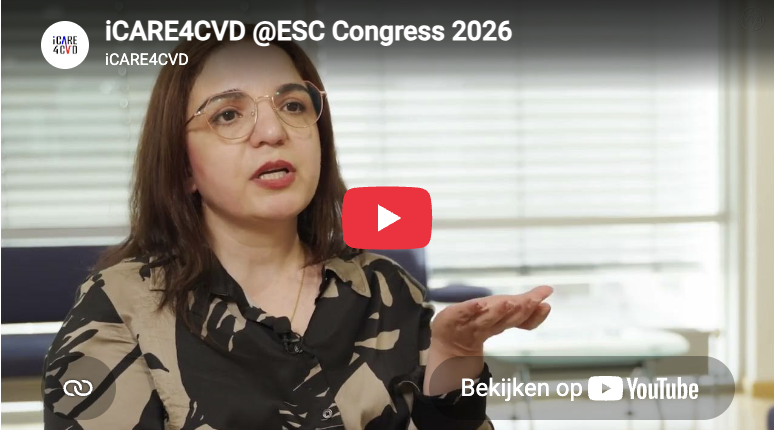
In this video produced by MediMix during ESC Congress 2026, Hajar shares insights into her research and discusses the potential of causal machine learning to support personalised heart failure treatment.
A special thank you to MediMix for featuring Hajar and highlighting the research carried out within the iCARE4CVD consortium, and for kindly allowing us to share the video with our community.
Video credit: MediMix – originally produced and published as part of its ESC Congress 2026 coverage. Shared with permission.