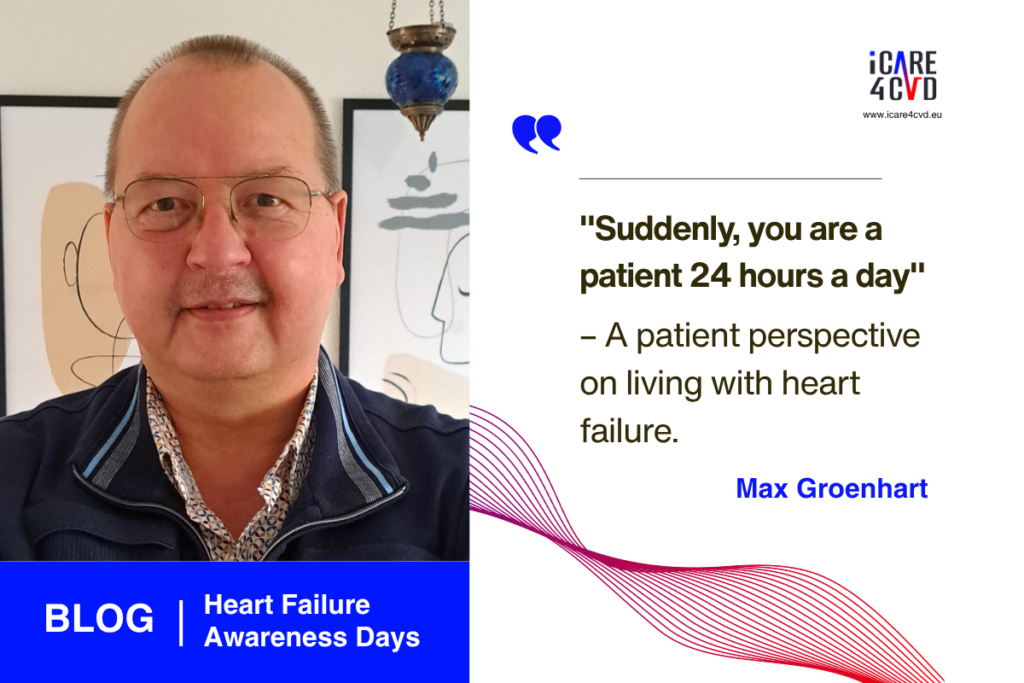
Heart failure affects millions of people worldwide, yet no two experiences are the same. Beyond its clinical definition, it is a condition that reshapes everyday life – impacting energy, independence, and even the simplest daily activities. As healthcare moves towards more personalised approaches, listening to patients is essential.
In this article, we speak with Max Groenhart about his journey with heart failure, his role in the project’s Patient Advisory Board, and why involving patients in research is key to improving outcomes.
Max’s diagnosis followed several weeks of severe fatigue and gastrointestinal symptoms. After multiple consultations and tests, blood results revealed signs consistent with a heart attack, leading to further urgent examinations. An echocardiogram ultimately showed that his heart function was severely reduced, with an ejection fraction of just 15–17%. Soon after, he learned he would need major surgery – five bypasses – to address the condition. What began as unexplained symptoms quickly became a life-altering diagnosis.
Before this, Max led an active life – working full-time, studying for a bachelor’s degree, and involved in various organisations. He initially believed recovery would take only a few months. Instead, the reality was very different. Even simple tasks became exhausting, and returning to work, even for a few hours a week, proved challenging.
“Suddenly, you are a patient 24 hours a day. The shift from a busy life to having no energy and seeing little improvement was very hard.”
Living with heart failure extends far beyond the individual. Max highlights how the condition affects relationships, daily routines, and entire support systems.
“It’s not just about me - it impacts my partner, our roles, and our whole social circle. You have to find a new way of living together.”
While Max is grateful for the care he has received, he highlights a common challenge: patients are often overwhelmed by complex advice and strict guidelines, with little preparation for how to manage it all:
“Advice is worthless if people cannot follow it. Trying to keep up with every rule can be frustrating, and without realistic, tailored support, much of it is quickly abandoned – much like New Year’s resolutions."
For Max, personalised care means more than medical treatment: it means guidance adapted to each individual’s lifestyle, environment, and expectations. This is exactly where initiatives like iCARE4CVD play a crucial role.
By integrating patient insights early in the research process, the project aims to ensure that solutions are not only scientifically sound but also practical and meaningful in real life.
“Involving patients makes research more valuable. These are real-life experiences we deal with every day.”
Looking ahead, Max hopes for a stronger focus on prevention, earlier diagnosis, and better use of research data to understand why treatments work differently for different people. Ultimately, the goal is clear: enable patients to live as normally as possible through truly personalised care.
Through his involvement in iCARE4CVD, Max is committed to ensuring that patient voices remain at the heart of research:
"I want real-life experiences to shape the questions we ask. That’s how we improve outcomes.”
As we mark Heart Failure Awareness Days, his story is a powerful reminder: advancing care starts with listening.