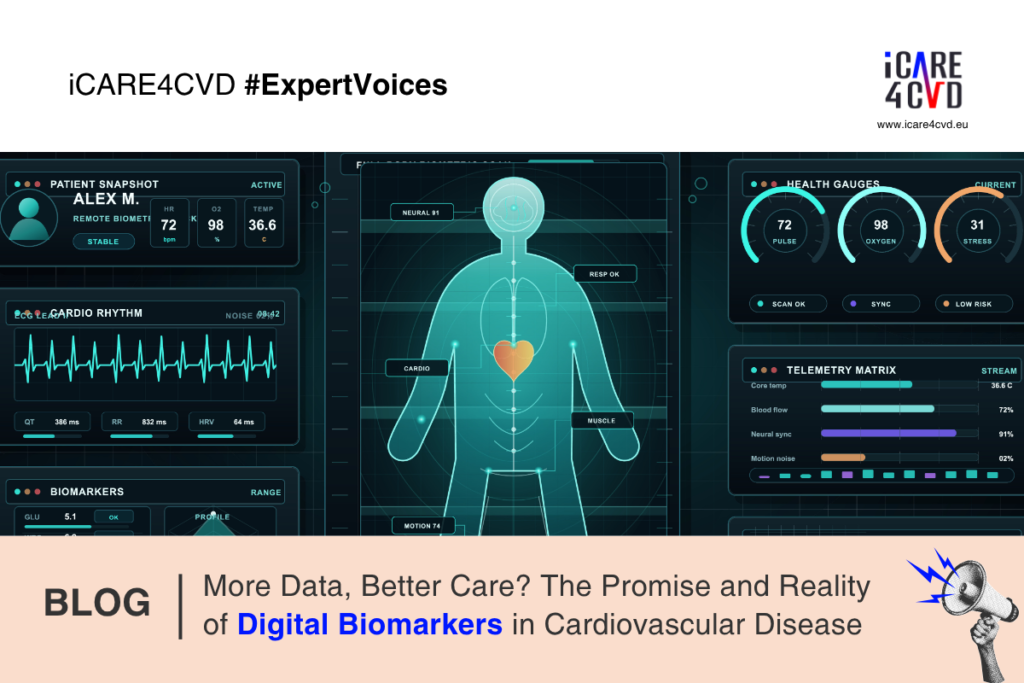
We have more data on our hearts than ever before. Smartwatches track our rhythm around the clock. Implanted sensors monitor pressure and flow. Algorithms flag irregularities before symptoms appear. So why are we still diagnosing cardiovascular disease too late?
The answer says something important about the gap between technological possibility and clinical reality – and it is exactly the gap that iCARE4CVD is working to close. We spoke with two researchers at the heart of this work: Christof Peters, cardiologist in training and PhD student at Maastricht UMC, and Nina Haring, scientist at TNO’s Digital Biomarker Lab – co-chairs of iCARE4CVD’s Digital Biomarker Working Group.
From clinical snapshots to continuous narrative
To understand why digital biomarkers matter, it helps to start with what a biomarker actually is. “A biomarker is quite literally a marker of a biological process,” explains Christof. “It is something we can measure that tells us something about a process going on in the body – from heart rate measured by counting your pulse at your wrist, to specific proteins in the blood that tell us about the progression of certain cancers.”
Digital biomarkers extend that principle into everyday life – objective, quantifiable measures collected through wearables, smartphones, or connected home-monitoring devices, without the need for a professional to perform the measurement. The critical shift they offer is one of continuity. “Whilst traditional biomarkers are a current snapshot of the patient,” says Christof, “digital biomarkers often provide a more continuous flow of information.”
That shift matters most in conditions where things can change quickly between appointments. Heart failure patients, for example, often arrive at consultations either appearing deceptively stable – where subtle deterioration is easy to miss – or already in a state that needed intervention weeks earlier, sometimes requiring hospitalisation that earlier detection might have prevented. “Managing chronic disease is a daily task,” says Christof, “where you not only have to take into account the present, but also the trend over time. This is precisely what makes digital biomarkers clinically compelling: the possibility of capturing a richer, more continuous picture of how someone is actually doing in daily life.”
But that potential plays out very differently depending on what a digital biomarker is actually for. In cardiovascular care, applications range from screening and early diagnosis, to preventing major adverse events (MACE), to tracking how a disease or treatment is progressing. Each serves a different purpose – and each comes with different evidence requirements and rules around use.
A tool that helps a patient self-manage their condition faces the lowest regulatory bar. One that informs a clinical decision faces more scrutiny. Tools used in clinical trials or to support reimbursement decisions face the highest standards. These distinctions matter, and getting the context of use right from the start shapes everything that follows: what evidence needs to be collected, how the tool is validated, and ultimately whether it will be accepted by clinicians, regulators, and payers.
So is more data actually better?
Not automatically. And this is where the conversation gets more interesting.
“More data do not automatically lead to better care,” says Nina. “Data only become valuable when they are interpretable, clinically relevant, trusted, and connected to clear actions.” For patients, that might mean reassurance between appointments, help interpreting a symptom, or knowing when to escalate.
Creating a digital biomarker that meets that standard is much more than training an algorithm on sensor data. First, it needs to be accurate – validated in the actual patient populations it is meant to serve – not just healthy volunteers. Consumer-grade wearables often use black-box algorithms with unknown training datasets, and research-grade tools are frequently trained on datasets that skew toward younger or healthier individuals, meaning their performance in patients with chronic illness, arrhythmias, or complex medication regimens can be uncertain. But accuracy alone isn’t enough. A biomarker also needs to be understandable, actionable, and usable in daily life. Does the output mean something to the patient using it? Can a clinician act on it? Does it fit into how people actually live? “A digital biomarker only becomes valuable,” Nina notes, “when it is reliable, clinically relevant, usable in daily life, and connected to a clear decision or need.”
Christof sees what happens when those conditions aren’t met. When tools are not adequately validated – or when thresholds for what constitutes a meaningful clinical change remain unclear – the risk is alert fatigue: systems that flag everything, overwhelming clinical teams without making them better informed. “A lot of noise is generated,” he says. This can make it more difficult for clinicians to identify information that genuinely requires action and can hinder the effective integration of digital monitoring into routine care.
What will it actually take to reach implementation?
Solving this requires more than better algorithms – it takes structured validation, meaningful patient involvement, regulatory alignment, and a clear path from evidence to practice.
On validation, efforts in the field have historically been fragmented, and frameworks such as V3+ – developed with the Digital Medicine Society and contributed to by TNO – are changing that, providing a shared standard that covers not just technical performance but clinical validity, usability, and real-world fit.
But equally important is who is involved in the development process, and patients shouldn’t be an afterthought. “A digital biomarker may be technically impressive,” Nina explains, “but patients help identify what outcomes are meaningful, what level of monitoring burden is acceptable, whether feedback is understandable, and how continuous monitoring affects trust, reassurance, or anxiety.”
Regulatory and health technology assessment bodies increasingly expect this kind of involvement during development and evidence generation – because the question is never just what can be measured, but what actually matters to the people living with the condition.
This multidisciplinary approach is central to iCARE4CVD. The project’s Digital Biomarker Working Group – bringing together clinicians, data scientists, and industry partners – is currently working with its Patient Advisory Board on the practical questions around implementing digital biomarkers in cardiovascular care, while also conducting a systematic review on digital monitoring in ambulatory heart failure patients to map where the evidence is strong and where the gaps remain.
A future worth working towards
For Christof, the future of cardiovascular care is one where connected devices, smart algorithms, and patient-facing tools work together to detect changes early, support self-management, and reduce the burden on overstretched healthcare systems. Closed-loop insulin systems in diabetes — where glucose patches communicate directly with insulin pumps, adjusting dosing in real time — already prove this kind of integration is possible in medicine. “Why shouldn’t we strive for this in other diseases?” he asks.
Nina shares that ambition, but is clear-eyed about what will make it achievable. “The future of digital biomarkers depends not only on technological advances, but on multidisciplinary collaboration between patients, clinicians, researchers, engineers, regulators, healthcare systems, and industry.”
The technology, in many cases, is ready. The evidence base is catching up. The question now is whether healthcare systems are prepared to meet both.